Why Your Sports App Never Shows the Score in Real Time
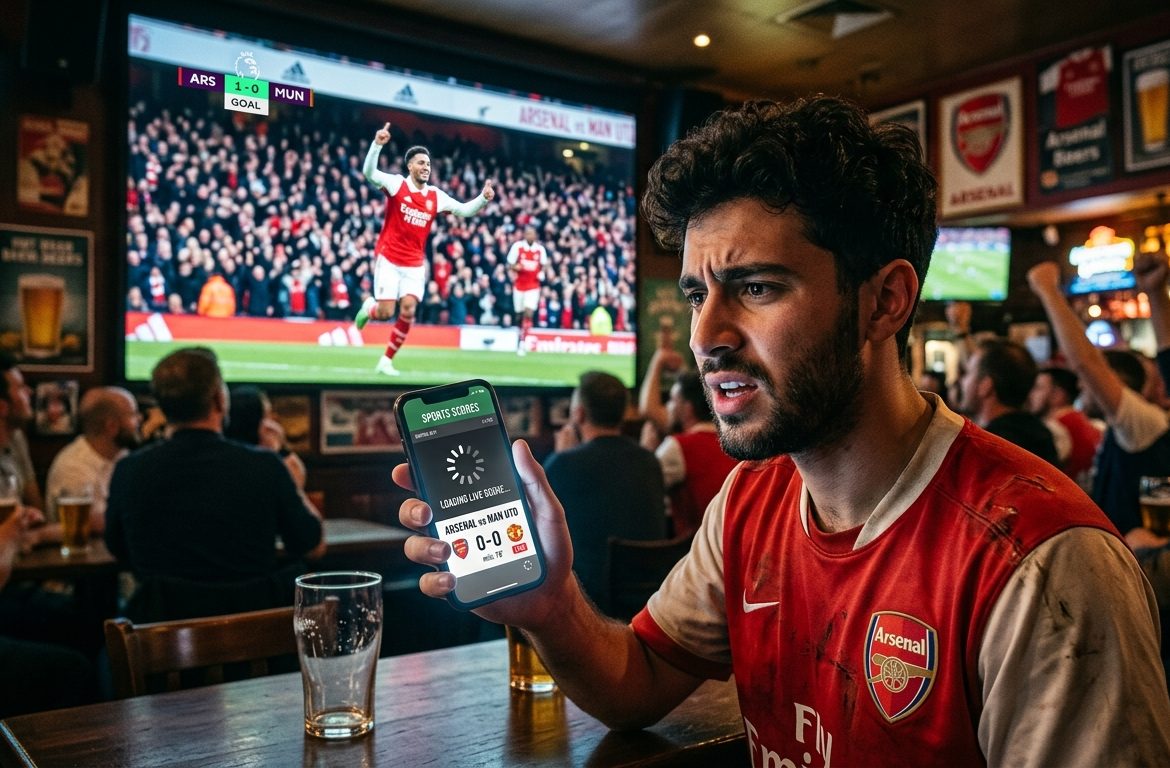
You’re watching the game. Your phone buzzes. You glance down at your sports app, and the score it shows is already old news. The play that just unfolded on screen? The app hasn’t caught up yet. It’s one of the most reliably frustrating experiences in modern sports fandom, and there’s a fascinating set of reasons behind it that goes far deeper than a slow internet connection.
Score delays are not a glitch , they are engineered into the system on purpose.
- Broadcast rights agreements legally require data feeds to run behind the live TV signal to protect exclusivity.
- Data licensing tiers mean different apps get different speeds , free apps almost always get the slowest feeds.
- Every hop in the chain from stadium to screen adds processing time that compounds into real-world lag.
The Moment a Play Actually Gets Logged
Consider what physically happens the instant a goal is scored or a touchdown is made. At most professional sporting events, a human operator seated in the stadium logs that event in real time. These are called live data scouts, and they are stationed at every major game, manually entering every scoring play, substitution, and stat into a proprietary system.
That human layer introduces the first delay. Even the fastest scout takes a couple of seconds to register what happened. That input then travels to a central server run by a sports data company. Firms like Sportradar and Stats Perform hold official data licensing agreements with major leagues, making them the authoritative source for stats and scores. Once the data arrives at their servers, it gets validated, formatted, and queued for distribution to the apps and websites that pay for access.
None of those steps is slow on its own. Stacked together, they add up quickly.
Broadcast Rights and the Intentional Hold
This is where legal reality shapes your experience as a fan. When a broadcaster pays hundreds of millions of dollars for the rights to air a league’s games, that deal comes with teeth. A core protection built into those agreements is live exclusivity. If a data app could surface the exact score the instant it happened, a fan could effectively follow the game in real time without ever watching the broadcast. That would hollow out the commercial value of the TV deal.
To prevent that, leagues and data companies write specific delay requirements into their licensing contracts. The technical concept of a broadcast delay has existed for decades in television and radio, originally introduced for safety and censorship reasons. In the modern data economy, it has taken on a second commercial function: protecting the primacy of the live broadcast signal above all other distribution channels.
This means that even if the underlying technology could push your score update in under five seconds, the contract between the league and the data provider can mandate a 30-second or longer hold before that data flows to any third-party app.
How Data Licensing Tiers Create Different Speeds for Different Apps
Your favorite sports app almost certainly does not have a direct deal with the league. It buys a data feed from an intermediary, which in turn holds the official license. Each layer of that arrangement comes with its own terms, its own pricing, and its own latency parameters.
Higher-tier licensing costs significantly more and allows faster delivery. Budget-friendly data tiers, which smaller and free-to-use apps typically purchase, carry longer built-in delays as part of their lower price point. Premium apps and legal sports betting platforms pay substantially more to receive faster streams. This is why two different apps running on the same phone can show different scores at the same moment during a close game.
Leagues benefit financially from keeping these tiers segmented. Slower data costs less, keeps the market accessible to smaller developers, and preserves the premium value of faster feeds for high-paying clients. The delay is not just a technical side effect. It is a feature of the pricing structure.
Why Delays Vary by Platform and Sport
Not every sport or platform runs on the same clock. American football, with its stop-and-start rhythm, tends to produce slightly shorter lags on premium feeds because each play is discrete and easier to log fast. Basketball and hockey move more continuously and can see longer processing times on budget tiers. Tennis is often well-served because each point is clean and finite. Soccer, despite its simplicity of scoring, can vary widely based on the provider and the licensing level the app purchased.
Research into live score delays across platforms consistently shows the same pattern: the vast majority of commercial data feeds run somewhere between 30 and 90 seconds behind what is actually happening on the field, with most free apps sitting closer to the slower end of that range.
Smart TVs and connected home devices often feel even slower than mobile apps. They rely on the same licensed feeds, but their background sync intervals and software update schedules can add extra seconds on top of the existing data delay. A notification on your phone might arrive at a different time than the same score update appearing on your television, even though both devices are pulling from the same upstream source.
The Infrastructure Stack Between Venue and Your Screen
After data leaves the official feed, it still has a journey ahead of it. Your app has to poll a remote server, receive the response, parse the data format, and update what you see on screen. If the app is set to check for updates every 20 seconds instead of every 5, that polling interval alone accounts for a visible and frustrating gap.
Server load compounds the problem during high-profile events. When millions of fans refresh the same app simultaneously during a championship final, the servers handling those requests face enormous queues. The data may already be ready and waiting, but the sheer volume of requests slows down delivery to each individual device. That congestion has nothing to do with the broadcast rights agreement upstream. It is purely a capacity problem downstream.
Data formatting adds small but real overhead too. Raw event data gets packaged into structured formats, transmitted, decoded, and rendered. Each parsing step is fast in isolation, but none of them is free.
Steps That Actually Help You Get Faster Updates
Some practical approaches genuinely cut down the lag, even if they cannot eliminate it entirely:
- Use the league’s own app. The NFL, NBA, MLB, and Premier League each publish official apps that typically hold faster data access because they are closer to the source than any third-party reseller.
- Consider a paid subscription tier. Many sports apps offer premium plans that license faster data feeds. The price difference is usually modest, and the latency improvement during close games can be noticeable.
- Adjust your app’s refresh interval. Settings menus on many sports apps let you shorten how often the app checks for new data. Switching from automatic to the shortest available interval shaves off real seconds.
- Disable battery saver mode during games. Power-saving states throttle background refresh. Your app may not be polling as frequently as you think when the phone is conserving battery.
- Watch streaming alongside your score app. Official broadcaster streaming apps often sync their in-stream score widgets with the broadcast feed, which can feel more accurate than a completely separate data app.
The Commercial Logic Nobody Spells Out
There is a version of this story where the delay is entirely a technical artifact, an unavoidable consequence of moving data around the world at scale. That version contains truth. But the fuller picture includes deliberate commercial choices made by multiple parties who benefit from the current arrangement.
Leagues could mandate faster data delivery across all tiers. Data providers could compress their latency at every price point. App developers could poll servers more aggressively. None of them routinely do, because the segmented model generates revenue at each layer. Broadcasters preserve live exclusivity. Data companies sell premium access at premium margins. Leagues collect licensing fees from every link in the chain. The delay persists not because it cannot be shortened, but because shortening it across the board would flatten the value of the premium tiers.
Getting Closer to the Final Whistle in Real Time
Knowing this does not magically fix the lag, but it does change how you approach the problem. The practical path to faster scores is always closer to the source: official league apps, paid subscription feeds, devices with background refresh fully enabled, and short polling intervals in the app settings.
A realistic ceiling still exists. Until broadcast rights agreements evolve, or until leagues restructure how they license live data, some gap between the stadium and your screen is a permanent feature of the landscape. Most fans will live with 30 to 60 seconds of delay no matter what app they choose. Knowing why that gap exists at least replaces the frustration with context. The score is on its way. It just has several contracts, a data pipeline, and a server queue to clear before it reaches your screen.