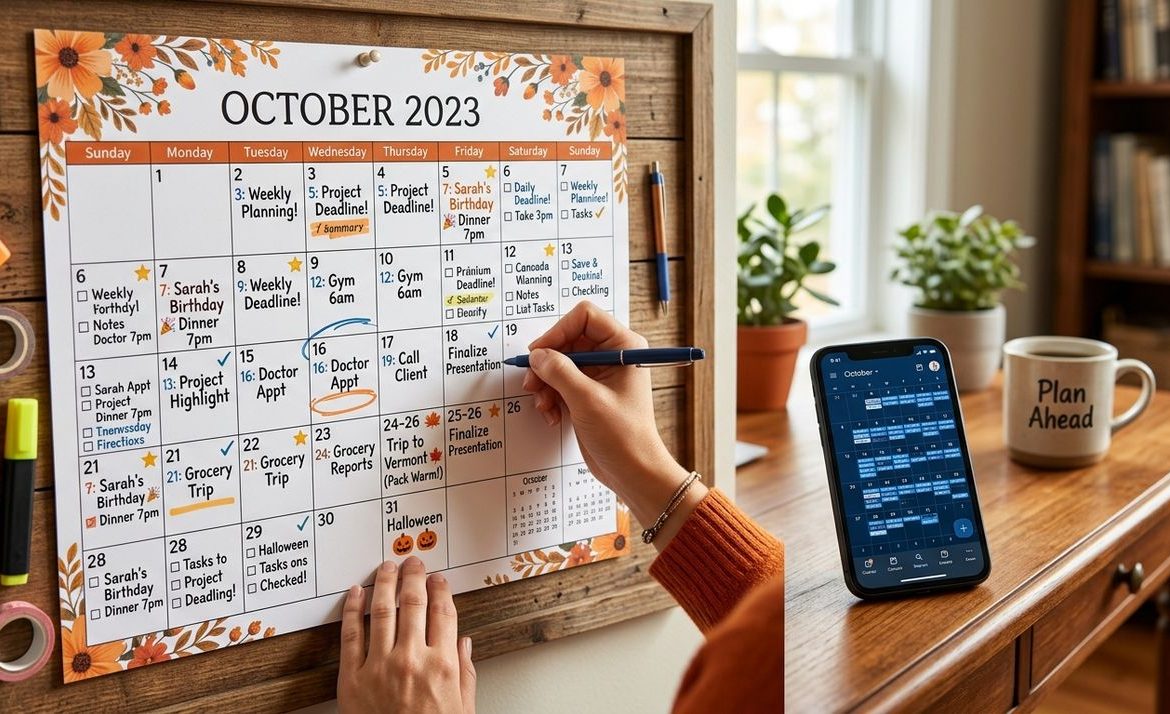
Why Printable Calendars Still Beat Apps for Day-to-Day Planning
Your phone has seventeen different apps that could, theoretically, help you stay organized. Most people use maybe two of them regularly. And even those two? They’re fighting for your attention against Instagram, news alerts, and a group chat that never sleeps. The humble paper calendar doesn’t do any of that. It just sits there, does its job, and lets you get on with your life. That might sound low-tech to the point of being quaint. But once you’ve tried it, the difference is hard to ignore.
Key Points:
1. Digital planning tools introduce constant friction and distraction, making paper calendars a genuinely more focused alternative for daily scheduling.
2. Handwriting your plans strengthens memory retention and creates a psychological commitment that typing simply cannot match.
3. Building a personalized paper calendar around your actual routines takes minutes and can transform how you manage your week.
The Problem With Digital Calendars Nobody Talks About
Here’s the thing nobody mentions in productivity articles: opening a calendar app on your phone is a trap. You unlock your screen to check Tuesday’s appointments, and three minutes later you’re reading about something completely unrelated. The notification badge on your email app caught your eye. Or a message preview pulled you off course. By the time you get back to your original task, you’ve lost the thread entirely.
This isn’t a willpower problem. It’s a design problem. Phones are built to grab your attention and hold it. Every app on your home screen competes for a share of your focus. Dropping your planning workflow into that environment and expecting it to stay clean is wishful thinking.
A paper calendar doesn’t have notifications. It doesn’t have a news feed running in the sidebar. It doesn’t ask you to update your payment details or rate your experience. It just shows you the month, the week, or the day, exactly as you set it up.
Friction-Free Planning Is the Real Goal
People talk a lot about productivity systems. They spend hours building the perfect digital setup, color-coding their Google Calendar, and connecting it to task managers and time trackers. And then they don’t use it, because the setup itself became the work.
Paper is the opposite. You write something down, and it’s done. No syncing required. No loading spinner. No app update that moves the button you’ve been tapping for six months.
The absence of friction matters more than most people realize. When planning feels easy, you actually do it. When it feels like a project, you put it off. And when you put off planning, the week gets away from you before you’ve had a chance to steer it.
What Handwriting Does to Your Brain
There’s real science behind why writing things down feels different from typing them. Researchers have found that the physical act of handwriting engages more of the brain than keyboard input does. You process the information more deeply, which means you’re more likely to remember it and more likely to follow through.
Research into handwriting shows that the act of forming letters by hand activates different cognitive pathways than typing, engaging motor memory alongside visual processing. That extra engagement isn’t just interesting trivia. It has real consequences for how well your plans actually stick.
When you write “dentist at 10am” in a paper calendar, you’ve done something different from adding it to an app. You’ve encoded it in a way that’s harder to forget. The appointment exists in your memory and on the page, rather than just in a database somewhere that you’ll need to remember to check.
The Psychology of Permanence
There’s something about ink on paper that makes plans feel more real. Deleting a task from an app is painless. It takes one tap. There’s no residual sense of having dropped something. Paper doesn’t let you off that easily.
If you skip something on a paper calendar, it’s still there tomorrow, slightly crossed out or circled again, asking you to deal with it. That’s not a bug. It’s a feature. The mild accountability of seeing undone tasks on a physical page is a surprisingly effective motivator for people who struggle with digital to-do list overwhelm.
This is part of why paper planning systems have seen a genuine cultural resurgence in recent years. The bullet journal method, developed by designer Ryder Carroll, built an entire global community around analog planning precisely because people were exhausted by digital alternatives that promised more than they delivered.
Where Paper Has a Clear Edge
Not every planning scenario calls for paper. But for day-to-day scheduling, paper has specific advantages that digital tools consistently fail to match:
- Morning planning sessions are faster and more focused on paper. You’re not navigating a touchscreen while your coffee cools.
- Weekly reviews are more satisfying when you can flip back through physical pages and see what you actually accomplished.
- Creative brainstorming benefits from the freedom of handwriting, where you can draw arrows, circle items, and scribble notes in the margins.
- Focus time improves when your schedule lives somewhere other than the device that also hosts your distractions.
- Family coordination is easier with a shared wall calendar that everyone can see at a glance without unlocking a device.
How to Build a Paper Setup That Actually Works
The biggest reason people abandon paper calendars is that they use a generic one. The months don’t quite match their rhythm. There’s no space for the things they actually track. The layout is designed for everyone, which means it’s optimized for no one.
The fix is straightforward: build a calendar around your actual life. Think about what you genuinely need to track. Is it weekly meal plans alongside your appointments? Project deadlines in a monthly overview? A habit tracker running alongside each week?
Here’s a simple process for getting started:
- List the three or four things you most often need to schedule or track in a typical week.
- Decide whether a monthly, weekly, or daily layout suits your workflow best. Most people do well with a weekly view for day-to-day tasks and a monthly layout for the big picture.
- Set a start date that makes sense for your life, whether that’s January or mid-July.
- Build your custom calendar with exactly the layout and structure you’ve chosen, then print it and put it somewhere you’ll actually see it.
That last step matters more than any other. A calendar tucked in a drawer is not a planning system. Put it on your desk, or mount it on the wall, somewhere that it catches your eye every morning.
Why the “Just Use Your Phone” Argument Misses the Point
The pushback against paper calendars usually sounds like this: “Why bother printing something when I already have everything in one place on my phone?” It’s a reasonable question. The answer is that “everything in one place” is not always a benefit.
Having your calendar in the same place as your social apps, email, news, and messaging means your planning gets contaminated by all of them. The phone is a tool that’s very good at many things. It is not particularly good at helping you stay focused on one thing.
Paper does one thing. It shows you your schedule. That constraint is the whole point.
Combining the Best of Both
The most effective paper planners don’t throw out their phones entirely. They use digital tools for the things phones are genuinely good at: reminders with alarms, shared scheduling with colleagues, travel bookings, and anything that needs to sync across multiple people or devices. They use paper for the things paper is good at: daily intention-setting, weekly planning, creative thinking, and the kind of focused, uninterrupted review that a screen-based tool actively works against.
That split is not a compromise. It’s a deliberate system built around how different tools actually perform.
Paper Planning and the Week You Keep Losing
The narrative that digital tools always outperform analog ones doesn’t hold up under real-world pressure. For a lot of people, the best productivity shift of the past few years wasn’t a new app or a subscription service. It was going back to paper for the parts of their planning that matter most.
If you’ve been running on digital-only scheduling and wondering why your weeks still feel chaotic, a printed calendar might be exactly what you’re missing. Not because it’s nostalgic. Not because apps are bad. But because paper removes the noise between you and your plans, and that quiet is worth more than any feature set.