
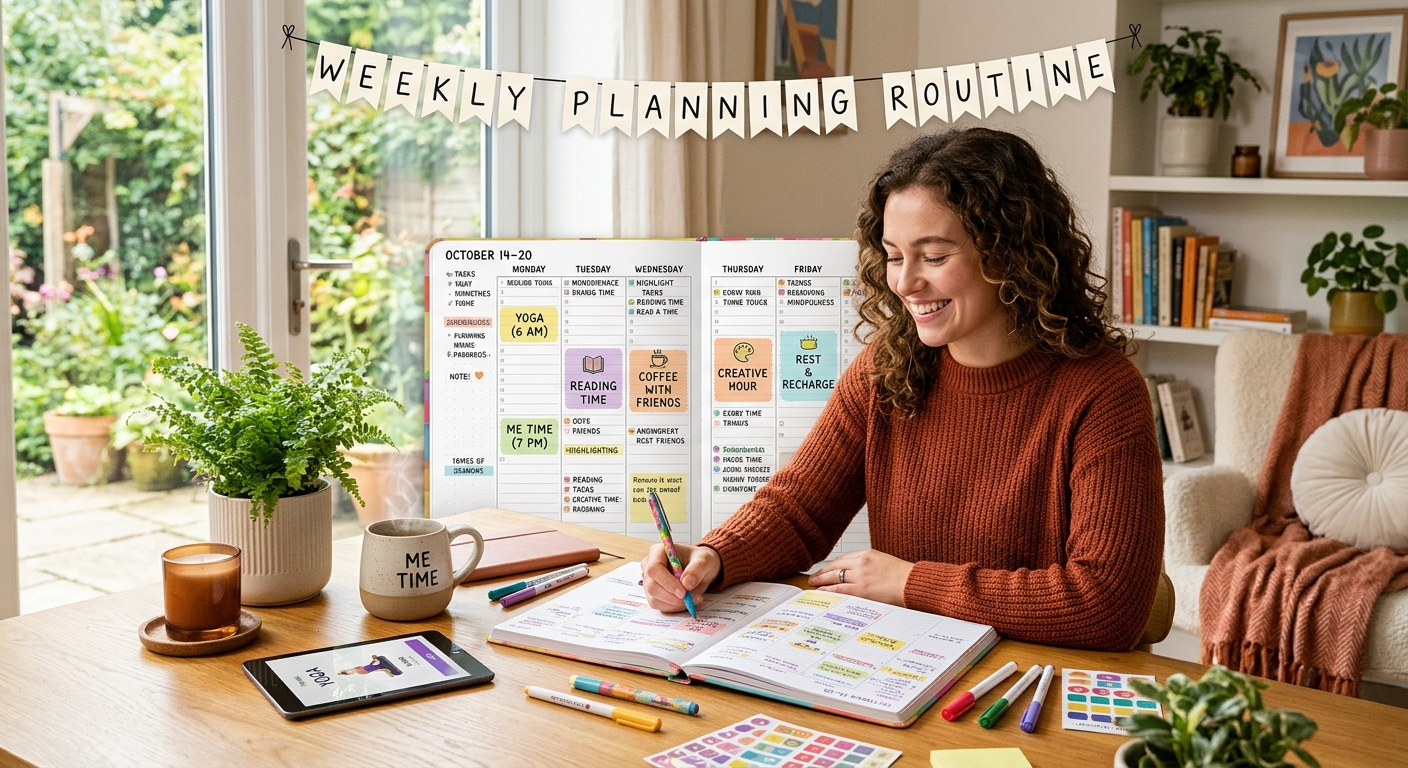
How to Build a Weekly Planning Routine That Leaves Room for Yourself
Your calendar can fill up before you have made a single choice about what you want from the week. Meetings arrive. Errands multiply. Someone needs a favor. By Friday, the book you wanted to read is still unopened, and your free time has become whatever survived everyone else’s requests. A weekly planning routine gives you a chance to make those choices earlier. The aim is to build a workable week that includes your responsibilities, your interests, and enough empty space to handle real life.
Three Anchors for a More Spacious Week
- Review your commitments before adding anything new.
- Give personal interests a realistic place in your calendar.
- Leave open time for changing plans and everyday needs.
1. Choose a Planning Time You Can Actually Keep
Pick a recurring moment when you can look ahead without rushing. Sunday afternoon might suit you. Friday before you close your laptop could work better. The best slot is one that fits your existing routine and gives you time to adjust plans before the week starts.
Start with about 20 minutes. Set a timer if planning tends to turn into an elaborate project. Keep your digital calendar, task list, and somewhere to jot down thoughts within reach. You do not need a new app or a polished template.
Give this appointment a plain name, perhaps “Plan the Week.” If your chosen time repeatedly falls apart, move it. A routine should fit your life closely enough that you can return to it after a busy stretch.
2. Gather Your Commitments in One View
Before arranging your week, find out what is already in it. Open the calendars you use for work, home, appointments, and shared plans. Check messages or notes for anything you agreed to but never recorded.
If you keep separate calendars, display them together when possible. You can keep their permissions separate while still seeing your own commitments in one place. Check sharing settings before adding private details to a work calendar.
Look beyond appointments. A deadline might require several hours of preparation. A dinner across town needs travel time. An early appointment may affect the evening before it.
- Check fixed appointments, work hours, deadlines, and travel.
- Include household tasks, caregiving, and existing social plans.
- Flag commitments that still need a time, location, or confirmation.
- Remove canceled events and reminders that no longer apply.
As you review, notice what is optional. An invitation does not automatically become a commitment. A task carried over for several weeks may need a clearer next action, a later date, or a decision to drop it.
3. Work Out How Much Time the Week Really Holds
A blank calendar can suggest that you have more room than you do. Meals, getting ready, commuting, cleaning up, and recovering after a demanding day all take time. Account for those needs before filling the remaining gaps.
Look at each day as a whole. If Tuesday includes a full workday and an evening appointment, it probably cannot also hold a major home project. You may technically have an hour available, but that hour might be what makes the day manageable.
Think about energy as well as hours. If you usually feel drained after a day of calls, that evening may suit reading or cooking something familiar. A task that needs concentration could fit better on a quieter morning.
Use your recent experience to judge what is realistic. If an errand usually takes an hour, give it an hour. Building a plan around your fastest possible performance leaves little room for ordinary delays.
4. Pause for a Reflection Ritual You Enjoy
Before choosing priorities, take a few minutes to step away from the logistics. Pair this pause with something you already enjoy: making tea, listening to one song, sitting outside, or writing in a favorite notebook. Keep it small enough that it feels inviting.
Ask yourself what felt satisfying last week. Then ask what you missed. Perhaps you finished several tasks but barely spoke to a friend. Perhaps you had plenty of company and now want an evening alone. These observations can help you decide what deserves space next.
If astrology is something you enjoy, reading a Virgo weekly horoscope can offer an optional starting point for journaling. Treat it as a creative prompt. Pick a theme that catches your attention, then ask how it relates to your own experience. You might write about where you want clearer boundaries or what you would like to give more attention.
Keep your decisions grounded in your circumstances. A few honest sentences are enough. The ritual has done its job when you have a clearer sense of what you want the week to include.
5. Choose a Small Set of Weekly Priorities
Use that reflection alongside your commitments to choose a few priorities. Three is a useful starting limit: one meaningful responsibility, one piece of everyday upkeep, and one thing that matters to you personally. Adjust the number when your circumstances call for it.
Make each priority specific enough to act on. “Get organized” leaves you with another decision. “Sort the papers on the kitchen counter” gives you somewhere to begin. “Make time for creativity” becomes easier to schedule when you choose to sketch for 30 minutes.
A priority does not have to be a large achievement. During a demanding week, arranging an overdue appointment or spending an unrushed hour with your partner may deserve your attention.
Keep the rest of your tasks on a separate list. You can return to them if capacity opens up. They do not all need a reservation on this week’s calendar.
6. Turn Priorities Into Flexible Calendar Blocks
With your fixed commitments visible, add time for the priorities you selected. Use clear event names that tell you what to do when the block begins. “Draft the opening section” is easier to start than “Work on project.”
Choose a duration that matches the task. A phone call might need 15 minutes. Preparing a document could take an hour. If the work is unfamiliar, allow some extra room and revise your estimate after trying it.
Distinguish appointments from flexible blocks through labels or a small set of colors. This helps you see what can move when something changes. Avoid creating so many categories that maintaining the calendar becomes another chore.
Set reminders selectively. An appointment away from home may need an alert early enough for travel. A flexible block at your desk may need no alert at all. Choose what helps you act without making your phone interrupt you all day.
7. Give Personal Interests a Modest, Protected Place
Add something you want to do before every available evening fills up. Choose an activity you would enjoy this week, rather than something you feel you ought to enjoy. That could be gaming with a friend, baking, swimming, reading, or repairing an old piece of furniture.
Begin with a manageable amount of time. A half hour with your guitar may fit more comfortably than an ambitious two-hour session. A smaller plan is also easier to keep when the week becomes busy.
Leave the activity itself open when that feels better. You can reserve an evening for personal time without deciding exactly how to spend it. When it arrives, choose according to your energy and mood.
- Choose one interest you feel drawn to right now.
- Reserve a realistic amount of time for it.
- Include any preparation, travel, or cleanup it needs.
- Move the block thoughtfully if another commitment takes its place.
You do not need to turn leisure into another performance target. An enjoyable hour still counts if you finish nothing, learn nothing measurable, and leave your phone untouched.
8. Leave Gaps That Can Absorb Everyday Changes
Once the main blocks are in place, resist filling every remaining space. Leave room between activities that involve travel or preparation. Keep part of an evening or a weekend afternoon unassigned when your circumstances allow it.
These gaps have a practical purpose. They give a delayed appointment somewhere to spill over. They let you handle an unexpected errand without rearranging the entire week. They also leave room to accept a spontaneous invitation or simply rest.
If your schedule is already crowded, create space by reducing a commitment rather than squeezing everything closer together. Shorten a task, postpone something optional, or ask whether a meeting needs your attendance. Even a little breathing room can make the plan easier to use.
9. Make One Brief Adjustment During the Week
Choose a point around the middle of the week for a short check. Look at what changed, what still matters, and what no longer fits. Move flexible blocks to specific openings instead of leaving them stranded in the past.
When a task remains unfinished, ask what happened. Perhaps it needed more time. Perhaps the next action was unclear. Perhaps another responsibility took priority. Use that information to adjust the plan without turning the review into a judgment of your effort.
Avoid automatically loading everything onto Friday. If there is no suitable space left, decide what can wait until next week. Carrying a task forward deliberately is more useful than pretending an already full day can hold it.
Build a Week You Have Room to Enjoy
Your weekly planning routine can stay simple: review what is coming, notice what you need, choose a few priorities, and give them realistic places in your calendar. Leave some gaps. Check the plan once the week is underway.
After a few weeks, look for patterns. You may need more travel time, fewer evening commitments, or an earlier place for personal interests. Let those observations shape the next plan. A useful calendar helps you meet your responsibilities while still leaving you time to live the week you are planning.
