How to Use Emojis in Business Messages Without Looking Unprofessional
Workplace communication has quietly shifted. The stiff, formal exchange is not entirely gone, but it has plenty of company now. Emojis appear in customer texts, team Slack threads, and branded social captions with increasing regularity. For many professionals, the real challenge is not whether to use them. It is knowing exactly when and how to use them without eroding the impression they have worked hard to build.
The Short Version
Emojis strengthen professional messages when used with intention, but the same symbol that reads as warm in a Slack thread can feel flippant in a client email. Reading your audience, matching your platform, and choosing symbols that add meaning rather than dilute it makes all the difference. Used sparingly and deliberately, emojis build warmth and clarity. Used carelessly, they undermine the message you worked hard to write.
The Shift Toward Visual Language in Professional Settings
Over the past decade, the tools people use to communicate at work changed considerably. Internal platforms like Slack and Microsoft Teams rewired expectations around tone. Mobile texting became a standard channel for customer service. Social media turned captions into crafted expressions of brand personality. All of this created space for emojis to appear in places they once would never have been welcome.
Research in digital communication has found that emojis can signal emotional nuance that plain text consistently misses. A message reading “Good work on that pitch” lands neutrally. That same message with a well-chosen positive symbol reads warmer, especially in a text-heavy channel where readers cannot hear your voice or see your face. The human instinct to read tone into text is strong, and when no tone is present, people tend to fill the gap with something neutral or negative by default.
That does not mean emojis are always appropriate. Professional contexts are not a single category. A startup’s internal chat channel operates under entirely different norms than a corporate law firm’s client correspondence. The first step is understanding which environment your message is entering.
Reading Your Audience Before You Pick a Symbol
Every professional message has an audience. The closer and more established your relationship with that person, the more room you have to be expressive. If you and a colleague have been trading casual messages for years, a well-placed emoji signals genuine familiarity. If you are writing to a new contact, a prospective client, or someone significantly senior to you, clear and direct language is a safer starting point.
Industry and role carry real weight here. Creative agencies, consumer brands, tech companies, and media organizations typically operate in cultures where expressive communication is built into the environment. Legal practices, financial advisory firms, healthcare providers, and government agencies tend to hold to more formal standards by necessity. A message that fits perfectly in one context can read as careless or underprepared in another.
Communication preferences tied to generation also matter. Professionals who have been in the workforce for decades did not grow up with emojis as a communication tool and may read symbols as casually dismissive. Younger colleagues and customers are far more likely to view them as a natural part of setting tone. Neither instinct is wrong. Your job is to meet your audience where they are, not where you are.
Contexts Where Emojis Genuinely Work in Your Favor
Internal team communication is the most forgiving space. Slack messages, Teams chats, and group texts among people you work with regularly are informal by design. A celebration symbol after a team win, a thumbs-up to confirm you have seen something, or a laughing face after a shared joke all do real relational work. They keep digital communication from feeling like a printed form.
Customer-facing texts are another strong case. Appointment reminders, delivery updates, and service confirmations all benefit from a touch of warmth. A short text that ends with a simple, relevant symbol reads more humanly than a string of plain operational language. For service businesses especially, that small addition can make a customer feel recognized rather than processed.
Branded social captions are where emojis become a deliberate stylistic choice. They break up long stretches of text, draw the eye toward key phrases, and reinforce the brand’s personality. The key is consistency. If a brand has built a voice around expressive, symbol-rich captions and then suddenly posts something stripped of that texture, the tonal shift creates confusion rather than sophistication.
Situations Where Emojis Can Hurt Your Message
Formal correspondence is not the place for symbols. Proposals, contracts, dispute resolutions, and first-contact emails to senior stakeholders should read professionally and without decoration. Placing an emoji in that context signals to the reader that you may not be taking the situation as seriously as they are.
Sensitive subjects carry the same risk. If you are delivering difficult news, addressing a client complaint, or writing a message that involves any form of correction or performance feedback, measured language does the work. An emoji following a hard message can feel dismissive, as though you are trying to lighten something the reader needs to process carefully.
Cross-cultural communication adds a further layer. A symbol with clear positive meaning in one context may carry different associations elsewhere. The thumbs-up gesture, for instance, is considered offensive in parts of the Middle East and West Africa. When corresponding internationally without certainty about cultural context, leaving symbols out entirely is the more respectful call.
Industries and Roles That Default to Emoji-Free Communication
Legal professionals, medical practitioners, financial advisors, public officials, and those in executive or investor-facing roles operate under communication norms that consistently favor formality. Any message that may become documentation, be forwarded beyond its original recipient, or carry legal weight should stay clear of informal symbols. Press statements, formal complaints, and written exchanges that could be reviewed by a third party all fall into this category.
A Step-by-Step Process for Choosing the Right Emoji
Rather than reaching for whatever symbol appears first in your keyboard’s suggestion row, a more deliberate approach produces better results. Work through the following before you send:
- Identify your audience and your standing relationship with them. The more established and informal the connection, the more latitude you have to be expressive.
- Consider the platform. A Slack reply and a formal client email are not held to the same standard. The medium shapes reader expectations before they read a single word.
- Clarify what you want the emoji to accomplish. Are you celebrating something, confirming receipt, softening a message, or adding emphasis? The symbol should serve that specific purpose.
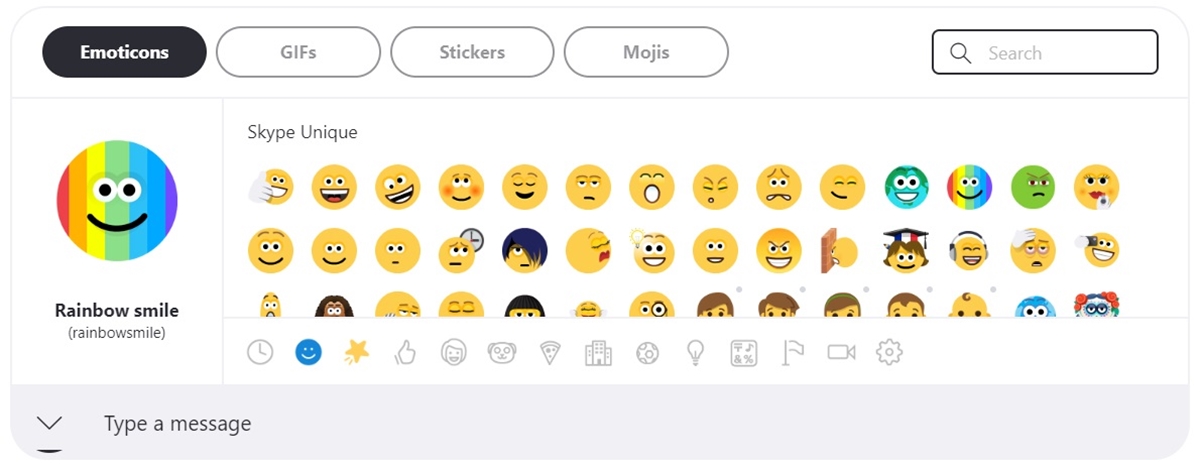
- Browse by category rather than defaulting to habit. Using a categorized emoji list organized by type makes it straightforward to find a contextually appropriate option instead of gravitating toward the same five symbols every time.
- Read the full message back with the emoji in place. If removing it changes nothing, it does not belong there. If it adds warmth, emphasis, or tone that the words alone are missing, it earns its place.
- Think about how the symbol will render across devices. Not every emoji looks the same everywhere. Running a quick visual check before sending to clients or customers is a small step that prevents unintended impressions.
How Frequency Shapes the Effect
One emoji in a message adds personality. Five emojis in the same message start to read as scattered or performative. There is no universal number that works in every situation, but a useful principle is to treat each symbol as an accent rather than a recurring pattern. It adds to the tone. It does not carry it.
Brands that pack every social caption with symbols eventually find that readers scroll past without registering any of them. The Unicode emoji standard specifies how symbols are encoded and displayed across operating systems, which means the same character can render with slightly different appearances on different devices , another reason that fewer, more deliberate choices tend to land better than dense collections. Selectivity is what keeps the impact intact.
For individual professionals, the same logic applies. A message dense with symbols shifts the tone from warm and confident to casual to the point of being dismissive. One considered symbol, placed where it genuinely adds something, reads as intentional. That distinction is what builds trust rather than quietly eroding it.
How Platform Norms Should Guide Your Choices
Email and emojis have an uneasy relationship that depends almost entirely on context. In casual internal emails to close colleagues, a single emoji can work naturally. In external business emails, especially first-contact messages or formal correspondence, they tend to undermine credibility. The formality of the medium shapes reader expectations before they have processed a single word.
Slack and Teams are built for informality, and reaction emojis are a core feature of those tools rather than an add-on. Using a thumbs-up reaction to acknowledge a message is standard workplace behavior in these environments. It signals attentiveness without generating a reply that adds noise to the thread. In this context, emojis function as a practical communication tool, not merely a stylistic one.
Customer text messages sit in the middle ground. One emoji placed near the end of a short message is typically the right approach. It adds human warmth to what would otherwise read as automated output, without tipping into casual territory that may not suit every customer’s preference or expectation.
Social media captions have the most flexibility. Symbols used in this space should align with an established brand voice, appear where they punctuate or reinforce a point, and stay relevant to the content rather than acting as decoration for its own sake.
Sending with Intention, Not Just Habit
The professionals who use emojis most effectively are not the ones who use them most. They are the ones who have thought carefully about each message’s purpose, its audience, and the tone they want to create. A symbol dropped from habit does none of that work. A symbol chosen deliberately can do a great deal of it.
That kind of intentionality applies to every element of professional communication. But emojis make the stakes visible in a way that plain language never does. A misplaced symbol can shift how a reader perceives your judgment, your attentiveness, or your seriousness in a single glance. That is a lot of weight for a small graphic to carry.
Getting it right does not require memorizing a long list of rules. It requires paying attention to who you are writing to and what you want them to feel when they read your message. Business communication is built on trust through repeated interaction. Emojis can contribute to that, or they can quietly chip away at it. The difference comes down entirely to whether you are reaching for them thoughtfully or just reaching.